
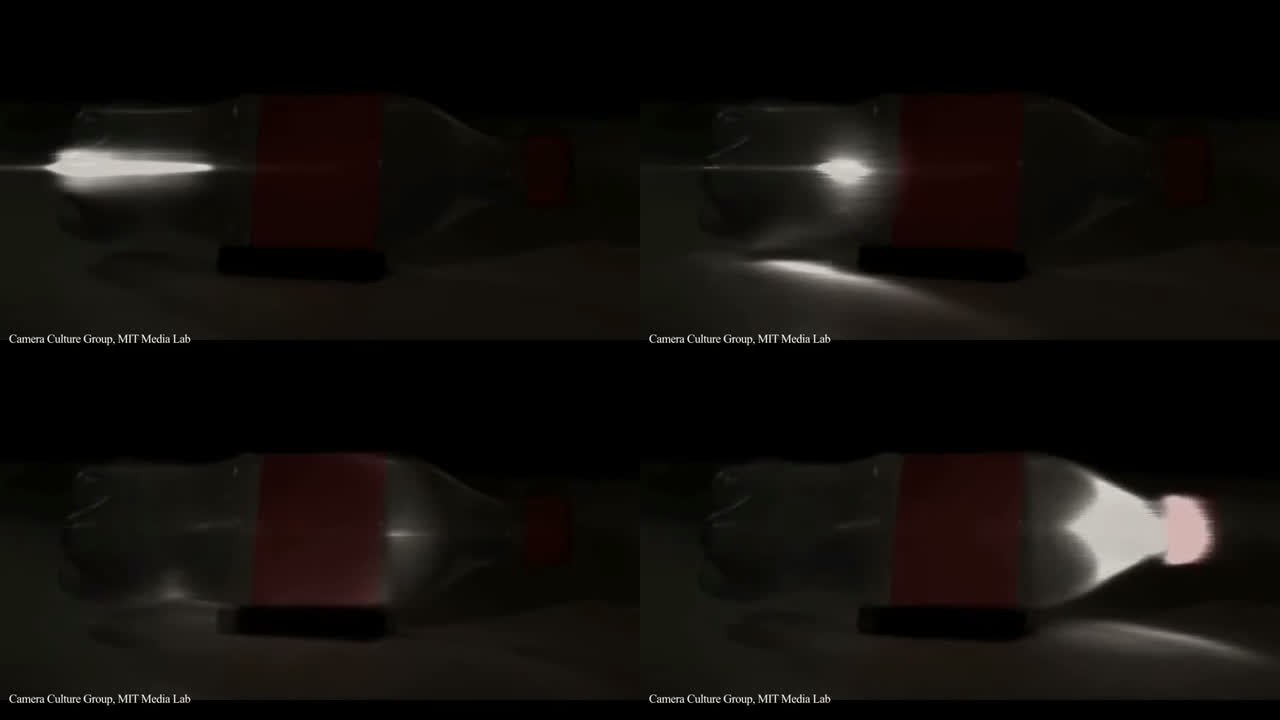
The video below was recorded at roughly one trillion frames per second (fps), fast enough to capture light itself as it travels. Yet this footage does more than showcase a remarkable technological achievement; it raises a profound question: at what "frame rate" does nature itself operate? Even at a trillion fps, the universe appears smooth, continuous and seamless. There is no lag, no visible pixel, and no break anywhere in the picture.
This question first struck me while I was studying sampling rate and sampling frequency in Digital Signal Processing (DSP). In any digital system, the sampling rate is always finite. Yet when a bird flaps its wings, when a leaf sways in the breeze, or when light moves across a scene as we have just witnessed, we never perceive pixelation or jerkiness. Nature behaves like an analog film playing at infinite resolution and infinite frames per second.
The simulation hypothesis#
What, then, is the secret behind this extraordinary smoothness? Is our universe genuinely analog? Or is it a simulation powered by such unimaginable computational capacity that no lag or glitch ever becomes visible to us? This line of thought leads directly to the door of the "Simulation Hypothesis."
The idea that the universe might be a computer simulation remains an early-stage hypothesis, still widely debated in both science and philosophy. This article does not attempt to prove or disprove it. Instead, through a careful thought experiment, it asks a narrower and more practical question: if this universe really were a simulation, how much computational power would be required to run it?
What is a simulation, and how does it work?#
Before going further, it helps to have a basic understanding of what a simulation is and how it works. In simple terms, a simulation is the digital recreation of a real-world event or system inside a computer environment. Its central goal is to build a virtual environment that resembles reality as closely as possible. A familiar example is the flight simulator used to train pilots: it reproduces the experience of flying a real aircraft so faithfully that trainees can practise safely on the ground. Building an effective simulation depends on several essential components:
- Purpose and scope: clearly defining what exactly will be simulated and where the boundaries of the model lie.
- In-depth knowledge: a clear and thorough understanding of the laws that govern the subject being simulated, such as physics or chemistry.
- Mathematical model: precise equations capable of describing and predicting the behaviour of the real system.
- Computational resources: the processing power (CPU and GPU), memory (RAM) and storage required to run the model.
- Validation: verifying how accurately the simulation reflects reality.
From a flight simulator to a universe simulator#
Moving from a flight simulator to a simulation of the entire universe is nothing short of a cosmic leap. It would require a single, unified model capable of explaining not only the behaviour of atoms and molecules, but every law of the universe: life, consciousness, emotion and economics, all the way to the motion of planets and stars.
To appreciate this complexity, consider a simple, everyday example: a person looking at a red rose. Behind this seemingly ordinary experience lies an astonishingly intricate process that unfolds across several distinct layers:
- Quantum level
Photons, the particles of light, travel from the Sun and strike the rose. The molecules of the rose absorb every wavelength of light except red. The reflected red photons then travel onward and enter our eyes.
- Chemical level
Each photon strikes a light-sensitive molecule in the retina called rhodopsin. This triggers a chemical reaction that changes the structure of the molecule.
- Bio-electrical level
This chemical change generates an electrical signal in the optic nerve.
- Neurobiological level
The signal travels through billions of neurons in the brain until it reaches the visual cortex.
- Conscious and emotional level
The brain interprets the signal as the colour "red" and connects it with the person's memories and emotions. Perhaps, in that moment, they feel the beauty of the rose.
Simulating each of these layers, first individually and then together as one integrated system, would be an almost impossible undertaking.
The limits of human knowledge#
But is the knowledge and science we take such pride in truly ready for a task of this magnitude? The honest answer is: not at all. According to modern cosmology, the universe is approximately 13.8 billion years old, yet humanity has been seriously studying the universe and its laws for little more than a century. We know that what we know is remarkably little. Can even that limited knowledge be accurately expressed as a single, unified model? The likelihood is extremely low.
Consider physics as an example. For nearly a century, scientists have been trying to unify the four fundamental forces of nature (gravity, electromagnetism, and the strong and weak nuclear forces) into one single theory, and they have not yet succeeded. Yet any complete model of physics would first need to bring these four forces together. The same is broadly true of every other field. Chemistry, biology, economics, mathematics and philosophy each lack a unified theory capable of explaining everything within their own domain.
Because our knowledge is limited, we will make some reasonable simplifications in order to grasp the scale of this enormous task, and we will build an approximate model based on what we know today. Such a model cannot capture only the smallest scale of reality; it must be multi-scale. In other words, it must accurately simulate the laws, behaviour and interactions of every level of existence, from the Planck scale through the quantum, atomic, chemical, biological, psychological, social, planetary and cosmic levels. Each of these levels carries its own structural rules, contextual influences and systemic complexity.
Lessons from video games#
When we play a game on a computer or mobile phone, we often notice that the device heats up, the game freezes, or it shuts down altogether. This happens because every game is itself a simulation model, and running it requires a certain amount of processing power (CPU and GPU), memory (RAM) and other resources. A typical modern game is designed to run at between 30 and 300 frames per second (fps) at Full HD or 4K resolution. This brings us to the central question: if the universe itself were a simulation, what would its resolution and frame rate be?
The resolution and frame rate of the universe#
As far as current physics tells us, the smallest meaningful length in the universe is the Planck length, approximately 1.616 × 10⁻³⁵ metres. No distance shorter than this can be measured, nor is it thought to have any physical meaning. Therefore, the "pixel size", or resolution, of a simulated universe would be one Planck length.
In the same way, the smallest meaningful unit of time is the Planck time: the time it takes light to travel a distance of one Planck length. Its value is approximately 5.39 × 10⁻⁴⁴ seconds. The frame rate of a simulated universe would therefore be:
Calculating the power needed for one litre of space#
Before attempting to account for the entire universe, let us first estimate the computing power required to simulate a very small volume: a cube measuring 10 cm on each side. Its volume is 1,000 cubic centimetres, or 10⁻³ cubic metres, which is exactly the size of an ordinary 1-litre water bottle. Suppose that updating the state of each Planck cube once per Planck time requires approximately 10⁹ computational operations.
- Volume of one Planck cube
(1.616 × 10⁻³⁵ m)³ ≈ 4.22 × 10⁻¹⁰⁵ m³
- Number of Planck cubes in one litre
10⁻³ m³ ÷ (4.22 × 10⁻¹⁰⁵ m³) ≈ 2.37 × 10¹⁰¹ Planck cubes
- Total operations per second
(number of Planck cubes) × (frame rate) × (operations per update) = (2.37 × 10¹⁰¹) × (1.855 × 10⁴³) × 10⁹ ≈ 4.4 × 10¹⁵³ operations per second
| Quantity | Calculation | Meaning |
|---|---|---|
| Planck length | ℓP ≈ 1.616 × 10⁻³⁵ m | The "pixel size" of the simulation |
| Planck time | tP = ℓP ÷ c ≈ 5.39 × 10⁻⁴⁴ s | The time light takes to cross one Planck length |
| Frame rate | 1 ÷ tP ≈ 1.855 × 10⁴³ fps | Updates per second |
| One Planck cube | (1.616 × 10⁻³⁵ m)³ ≈ 4.22 × 10⁻¹⁰⁵ m³ | Volume of one "voxel" |
| Planck cubes in 1 litre | 10⁻³ ÷ (4.22 × 10⁻¹⁰⁵) ≈ 2.37 × 10¹⁰¹ | 1 litre = 10⁻³ m³ |
| Operations per second | (2.37 × 10¹⁰¹) × (1.855 × 10⁴³) × 10⁹ ≈ 4.4 × 10¹⁵³ | Assuming 10⁹ operations per cube per frame |
Putting the number into perspective#
The result of this simplified calculation is, quite simply, astonishing. Simulating just one litre of space, no bigger than an ordinary water bottle, at the Planck scale for a single second would require roughly 4.4 × 10¹⁵³ FLOPS (floating-point operations per second) of computing power. To understand how vast this number truly is, consider the following comparisons:
| Machine | Operations per second (approx.) | Machines needed |
|---|---|---|
| Smartphone (AI chip) | ≈ 4.4 × 10¹³ | ~10¹⁴⁰ |
| Personal computer | ≈ 4.4 × 10¹² | ~10¹⁴¹ |
| El Capitan | ≈ 1.8 × 10¹⁸ | ≈ 2.4 × 10¹³⁵ (~10¹³⁵) |
Machines needed = 4.4 × 10¹⁵³ ÷ (one machine's speed). The smartphone and computer speeds are round figures for today's devices; El Capitan's is its measured result of 1.809 exaFLOPS (1.809 × 10¹⁸) on the TOP500 list, where it is one of the world's most powerful supercomputers.
The entire observable universe contains roughly 10⁸⁰ atoms. Even if every single atom in the universe were transformed into an El Capitan supercomputer, simulating this one litre of space would still require the combined computing power of about 10⁵⁵ universes like ours.
Acknowledging our simplifications#
To arrive at this remarkable result, we took many shortcuts. In the interest of honesty, our limitations must be clearly acknowledged:
- We modelled the universe in only three spatial dimensions, whereas in reality it may involve more.
- We treated the Planck length and the Planck time as the smallest possible units, which remains a theoretical assumption.
- We entirely ignored essential components of computing, such as GPUs, RAM, storage and power supply.
- Assuming roughly 10⁹ operations per unit is a drastic simplification; the true complexity of a realistic model would be many times greater. In reality, no branch of knowledge has yet produced a unified model capable of explaining everything within its own field, let alone a complete model of the entire universe.
Conclusion#
This leads us to a humbling question: if simulating just one litre of space for a single second demands such unimaginable power, then how does this vast and boundless universe continue to run?
Sources & further reading
- Camera Culture Group, MIT Media Lab — Femto-photography: Visualizing photons in motion at a trillion frames per second — The video in this article; the project describes it as about a trillion frames per second.
- Velten, A. et al. (2013). Femto-photography: capturing and visualizing the propagation of light. ACM Transactions on Graphics 32(4) — The research paper behind the footage.
- NIST CODATA — Planck length — ℓP = 1.616255 × 10⁻³⁵ m
- NIST CODATA — Planck time — tP = 5.391247 × 10⁻⁴⁴ s
- TOP500 — June 2026 list — El Capitan: 1.809 exaFLOPS on the HPL benchmark.
- Bostrom, N. (2003). Are You Living in a Computer Simulation? Philosophical Quarterly 53(211) — The paper that started the modern simulation argument.